
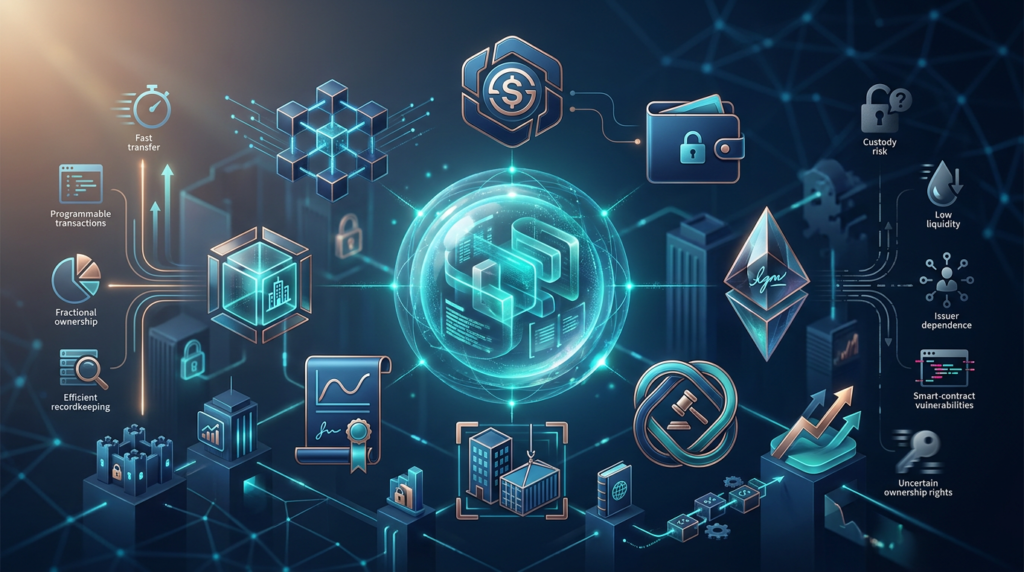
Digital assets are electronically recorded items that represent value, ownership, access, or contractual rights. They can be stored, transferred, traded, or used through digital systems. Examples include cryptocurrencies, stablecoins, tokenized securities, governance tokens, digital collectibles, and tokens linked to financial or physical assets.
The term does not describe one single asset class.
Two digital assets may use similar technology while providing completely different rights, risks, and economic functions. One token may be used to pay network fees, another may represent a company share, and another may provide access to a digital service.
Understanding a digital asset therefore requires more than identifying the blockchain or platform on which it operates.
The most important questions are:
- What does the asset represent?
- Who issued or controls it?
- What rights does the holder receive?
- How is ownership recorded?
- Who safeguards the asset?
- Where can it be transferred or traded?
- What happens if the issuer, platform, or custodian fails?
What Are Digital Assets?
Digital assets are items of value or rights that exist or are represented electronically.
In financial markets, many digital assets are issued and transferred through blockchain or distributed-ledger systems. Others may rely on centralized databases or platform-controlled records.
A digital asset may represent:
- payment value;
- ownership in a business;
- a debt obligation;
- access to a product or platform;
- voting rights;
- a claim on reserves;
- ownership of a unique digital item;
- an interest in a physical asset;
- a contractual right to future revenue.
The technology provides a way to record and transfer the asset.
It does not automatically determine whether the asset is valuable, legally enforceable, liquid, or safe.
Digital Assets Meaning in Financial Markets
In financial markets, digital assets generally refer to electronically transferable assets that can hold economic value or provide financial rights.
The value may come from:
- scarcity;
- network usage;
- issuer reserves;
- future cash flows;
- ownership rights;
- redemption rights;
- customer demand;
- access to a service;
- legal claims on another asset.
Some digital assets exist independently within a blockchain network.
Others are digital representations of traditional assets such as shares, bonds, deposits, commodities, investment funds, or real estate interests.
This distinction matters because the value of a native blockchain asset may depend on the network itself, while the value of a tokenized financial asset may depend on the issuer and the underlying instrument.
Digital Assets Are Not Digital Asset Management Software
The phrase digital asset management often describes software used by companies to organize business content.
A digital asset management system may store:
- photographs;
- videos;
- logos;
- advertisements;
- design files;
- presentations;
- marketing materials;
- product images.
That software category is commonly abbreviated as DAM.
This article uses the financial and digital-market meaning of digital assets. It does not review content-management platforms or digital asset management software.
Digital Asset, Crypto Asset, Virtual Asset, and Digital Security
These terms overlap, but they are not always interchangeable.
| Term | Practical meaning | Main distinction |
|---|---|---|
| Digital asset | Broad electronic representation of value, ownership, access, or rights | May or may not use blockchain |
| Crypto asset | Asset issued, recorded, or transferred through cryptographic networks | Usually depends on blockchain or distributed-ledger technology |
| Virtual asset | Digital representation of value that can be transferred, traded, or used for payment | Often used in regulatory and compliance contexts |
| Digital security | A share, bond, fund interest, or other security represented digitally | Securities rules may still apply |
| Tokenized asset | An existing or newly created asset represented through a digital token | Holder rights depend on the legal structure |
A token should not be classified only by its name.
An issuer may describe a product as a utility token even when the economic arrangement resembles an investment. Another token may appear similar to a cryptocurrency while actually representing a regulated financial instrument.
The holder must examine the rights and obligations attached to the asset.
Digital Assets Examples
Common digital assets examples include:
| Type | What it represents | Typical purpose |
|---|---|---|
| Native crypto assets | Value created within a blockchain network | Payments, network fees, collateral, participation |
| Stablecoins | Tokens intended to maintain a reference value | Payments, trading, settlement |
| Digital securities | Shares, bonds, or fund interests represented digitally | Investment and capital formation |
| Tokenized assets | Digital interests linked to financial or physical assets | Ownership, transfer, investment |
| Utility tokens | Access to a product, platform, service, or feature | Platform participation |
| Governance tokens | Voting or influence within a protocol | Decentralized decision-making |
| Non-fungible tokens | Unique digital records associated with specific items | Collectibles, licenses, memberships |
| Tokenized deposits | Digital representation of commercial bank money | Payments and settlement |
| Digital commodities | Digitally transferable assets treated as commodities | Trading, collateral, market participation |
The category does not determine quality.
A professionally issued tokenized bond and an unverified speculative token may both be digital assets, but they do not provide the same rights, protections, or risks.
Native Crypto Assets
A native crypto asset exists as part of a blockchain network rather than representing an asset held by an outside organization.
It may be used to:
- pay transaction fees;
- transfer value;
- reward network participants;
- secure the network;
- provide collateral;
- access applications;
- vote on protocol changes.
The value of a native asset may depend on:
- network adoption;
- transaction demand;
- token supply;
- technical reliability;
- security;
- governance;
- market liquidity;
- expectations about future use.
Holding a native crypto asset does not normally provide ownership of a company or a claim on its revenue unless the legal structure specifically creates those rights.
Stablecoins
Stablecoins are digital tokens designed to maintain a value linked to another asset, commonly a national currency.
A stablecoin may be supported by:
- cash;
- bank deposits;
- government securities;
- other financial assets;
- crypto collateral;
- algorithmic mechanisms;
- a combination of reserves and contractual arrangements.
The word stable describes an objective, not a guarantee.
A stablecoin can lose its reference value when:
- reserves are insufficient;
- redemption becomes restricted;
- the issuer loses access to banking services;
- market confidence declines;
- collateral falls in value;
- the stabilization mechanism fails.
Before using a stablecoin, examine:
- the issuer;
- the reserve structure;
- redemption terms;
- custody arrangements;
- reporting practices;
- applicable jurisdiction;
- transaction and withdrawal restrictions.
What Are Tokenized Assets?
Tokenized assets are financial, physical, or contractual assets whose ownership or economic rights are issued or represented through digital tokens.
The underlying asset may include:
- company shares;
- bonds;
- investment funds;
- bank deposits;
- loans;
- commodities;
- real estate interests;
- intellectual property;
- contractual revenue;
- physical products.
Tokenization can change how an asset is recorded, transferred, divided, or administered.
It does not automatically change the economic quality of the underlying asset.
For example, tokenizing an unprofitable business does not make the business profitable. Tokenizing an illiquid property does not guarantee an active market for the tokens.
Three Tokenization Structures
Native digital issuance
The financial instrument is created directly through a digital ledger.
The ledger may serve as the official ownership record.
Examples may include digitally issued bonds, shares, or fund interests.
Token representation
A token represents an asset maintained through another custody or recordkeeping system.
The underlying asset may be held by:
- a bank;
- a broker;
- a trust company;
- a special-purpose entity;
- another custodian.
The token holder’s rights depend on the agreement linking the token to the underlying asset.
Synthetic exposure
A token tracks the price or performance of an asset without giving the holder direct ownership.
The holder may receive a contractual payment based on price movements rather than the underlying asset itself.
This structure introduces additional counterparty and issuer risk.
Tokenized Assets Do Not Automatically Prove Ownership
A token displayed in a digital wallet does not necessarily prove direct ownership of the asset it references.
The holder may receive:
- direct legal ownership;
- beneficial ownership;
- a contractual claim;
- a security entitlement;
- a claim against a custodian;
- synthetic price exposure;
- limited platform access;
- no enforceable claim outside the platform.
The difference may become especially important during:
- insolvency;
- litigation;
- platform failure;
- asset recovery;
- restricted transfers;
- regulatory intervention.
Investors should review the legal documentation instead of relying on the token name or platform interface.
Digital Securities
Digital securities are shares, bonds, fund interests, debt instruments, or other securities represented through digital technology.
Examples may include:
- tokenized company shares;
- tokenized corporate bonds;
- digital investment-fund interests;
- tokenized debt agreements;
- digital revenue-sharing instruments.
Tokenization may improve:
- recordkeeping;
- settlement;
- transfer administration;
- ownership verification;
- compliance automation;
- corporate actions;
- investor reporting.
However, using blockchain does not remove the underlying financial and legal obligations.
A tokenized share is still connected to:
- company value;
- shareholder rights;
- disclosure;
- voting;
- dilution;
- transfer restrictions;
- investor protection.
Digital Securities and Startup Finance
Tokenizing company shares changes the recordkeeping method, but it does not replace startup valuation or determine what the company is worth.
A business may also offer regulated ownership interests through equity crowdfunding, although the legal and disclosure requirements remain separate from the token technology.
Utility Tokens
Utility tokens are intended to provide access to a product, network, service, or feature.
They may be used to:
- pay platform fees;
- purchase digital services;
- unlock functionality;
- reward participants;
- access memberships;
- obtain usage rights.
A token may have practical use while also being traded speculatively.
That creates a distinction between:
- actual demand for the service;
- demand for the token as an investment;
- demand created by incentives or speculation.
The long-term value of a utility token generally depends on whether the platform creates genuine and continuing user demand.
Governance Tokens
Governance tokens give holders the ability to participate in decisions involving a digital protocol or decentralized organization.
Voting may cover:
- fee structures;
- treasury spending;
- software upgrades;
- collateral rules;
- incentive programs;
- partnerships;
- risk parameters.
Governance rights can be limited by:
- low voter participation;
- concentrated token ownership;
- delegation;
- administrative control;
- emergency powers;
- developer influence.
A token may be described as decentralized even when a small group controls most practical decisions.
Non-Fungible Tokens
Non-fungible tokens, commonly called NFTs, are unique digital records associated with specific items, rights, or identifiers.
They may represent:
- digital artwork;
- collectibles;
- event access;
- memberships;
- game items;
- licenses;
- certificates;
- ownership records;
- links to physical products.
The token is not always the same as the associated content.
An NFT may provide ownership of the token without transferring:
- copyright;
- commercial-use rights;
- reproduction rights;
- ownership of a physical object.
The agreement and platform terms determine what the holder actually receives.
How Digital Asset Ownership Works
Traditional financial assets often rely on:
- banks;
- brokers;
- transfer agents;
- central securities depositories;
- company registers;
- government registries.
Blockchain-based assets may rely on:
- private keys;
- wallet addresses;
- smart contracts;
- distributed records;
- custodial accounts;
- legal agreements linking tokens to assets.
Technical control and legal ownership are not always identical.
A custodian may control the private keys while a customer remains the beneficial owner. In another arrangement, the customer may have only a contractual claim against the platform.
What Is a Digital Assets Custodian?
A digital assets custodian safeguards crypto assets, tokenized assets, digital securities, or the private keys used to control them.
Custody services may include:
- private-key storage;
- transaction authorization;
- account administration;
- asset segregation;
- reporting;
- access controls;
- recovery procedures;
- governance participation;
- compliance support.
Digital custody is more complex than storing an ordinary computer file.
A private key may authorize an irreversible asset transfer. If the key is stolen, lost, or misused, recovery may be difficult or impossible.
Self-Custody
Self-custody means the owner controls the private keys directly.
Possible advantages include:
- direct control;
- reduced dependence on an intermediary;
- access to blockchain applications;
- fewer platform restrictions.
Important risks include:
- lost recovery phrases;
- phishing;
- malware;
- device failure;
- incorrect transfers;
- inheritance difficulties;
- lack of customer support.
Self-custody transfers responsibility from an institution to the individual owner.
It does not eliminate risk.
Third-Party Custody
Third-party custody means a bank, exchange, broker, trust company, or specialist custodian controls or administers the assets.
Possible advantages include:
- institutional security controls;
- account recovery;
- transaction approval policies;
- reporting;
- compliance support;
- operational assistance.
Important risks include:
- insolvency;
- hacking;
- operational failure;
- withdrawal restrictions;
- asset commingling;
- unclear ownership priority;
- counterparty dependence.
The quality of the custodian matters as much as the technology used to store the asset.
Digital Asset Custodian Checklist
| Question | Why it matters |
|---|---|
| Who legally owns the asset? | Platform access may not equal ownership |
| Who controls the private keys? | Key control determines transaction authority |
| Are customer assets segregated? | Segregation may affect asset recovery |
| How are transfers approved? | Strong controls can reduce unauthorized transactions |
| What happens if the custodian fails? | Customers may be owners or unsecured creditors |
| Is insurance available? | Coverage may contain important exclusions |
| Are independent audits performed? | Audits may reveal weaknesses in internal controls |
| What recovery systems exist? | Lost credentials and operational failures require procedures |
| Which networks are supported? | Unsupported upgrades or forks can create problems |
| Can withdrawals be restricted? | Access may depend on platform rules and liquidity |
How Digital Asset Transactions Work
A digital asset transfer usually involves several steps:
- The owner initiates a transaction.
- The transaction is digitally authorized.
- The network or platform verifies the instruction.
- The ownership record is updated.
- The recipient receives technical control or an account credit.
- Legal settlement may occur immediately or through a separate system.
The exact process depends on whether the asset is:
- native to a blockchain;
- held through a custodian;
- represented through a broker;
- linked to an external asset;
- subject to transfer restrictions.
A blockchain transaction can be technically final while the legal ownership issue remains disputed.
Benefits of Digital Assets
Faster transfers
Digital networks may allow assets to move outside traditional operating hours.
Actual availability can still depend on:
- network confirmation;
- compliance checks;
- platform controls;
- custody systems;
- legal settlement rules.
Programmability
Smart contracts can automate:
- distributions;
- interest payments;
- collateral management;
- ownership updates;
- transfer restrictions;
- compliance checks;
- voting.
Automation may reduce manual administration but also introduces software risk.
Fractional ownership
A high-value asset may be divided into smaller digital interests.
Fractionalization can lower the minimum investment amount, but it does not guarantee market liquidity.
Improved recordkeeping
A shared ledger can provide a consistent record of issuance, ownership, and transfers.
The record remains useful only when:
- the original data is accurate;
- system governance is reliable;
- legal institutions recognize the record;
- administrators cannot manipulate it improperly.
Automated transfer controls
Digital assets can contain rules related to:
- investor eligibility;
- geographic restrictions;
- holding periods;
- transaction limits;
- approval requirements.
Automation can support compliance, but it cannot replace legal analysis or reliable identity verification.
New settlement and collateral uses
Digitally represented bonds, deposits, stablecoins, and other assets may be used for:
- payments;
- collateral;
- settlement;
- treasury management;
- financial-market infrastructure.
The benefits depend on interoperability, legal certainty, operational reliability, and sufficient adoption.
Limitations of Digital Assets
Technology does not create liquidity
An asset can be divided into thousands of digital tokens and still have few buyers.
Liquidity depends on:
- investor demand;
- market makers;
- trading venues;
- disclosure;
- transfer eligibility;
- market confidence.
Digital records cannot verify every external fact
A blockchain may accurately show that a token moved between two addresses.
It may not independently prove:
- that a property exists;
- that reserves are sufficient;
- that an issuer is solvent;
- that legal documents are valid;
- that the holder owns the underlying asset.
External facts often depend on custodians, auditors, courts, administrators, and data providers.
Programmability creates software risk
Smart contracts may contain:
- coding errors;
- upgrade vulnerabilities;
- administrator privileges;
- oracle dependencies;
- governance weaknesses;
- incompatible integrations.
Automation can make a system faster while also allowing errors to spread more quickly.
Tokenization may add intermediaries
A tokenized asset may require:
- an issuer;
- a platform;
- a custodian;
- an administrator;
- a wallet provider;
- a broker;
- an oracle;
- an underlying asset holder.
The structure may become more complex rather than simpler.
Main Digital Asset Risks
Market risk
Prices may change rapidly because of:
- speculation;
- low liquidity;
- leverage;
- concentrated ownership;
- changing demand;
- market sentiment.
Custody risk
Assets may be lost through:
- stolen private keys;
- phishing;
- malware;
- operational failure;
- custodian insolvency;
- incorrect transfers.
Issuer risk
The value of an asset may depend on an issuer’s ability to:
- maintain reserves;
- process redemptions;
- operate a platform;
- protect underlying assets;
- meet contractual obligations.
Smart-contract risk
Defective code may cause:
- unauthorized transfers;
- locked assets;
- incorrect payments;
- governance attacks;
- financial exploitation.
Liquidity risk
A displayed market price does not guarantee that a large position can be sold at that price.
Low trading activity may produce:
- wide price spreads;
- large price movements;
- delayed execution;
- inability to exit.
Operational risk
Failures may occur in:
- exchanges;
- wallets;
- custodians;
- bridges;
- networks;
- data providers;
- settlement systems.
Legal and regulatory risk
Legal classification can affect:
- who may issue the asset;
- where it may trade;
- which disclosures are required;
- whether intermediaries must register;
- which investors may participate;
- how customer assets are protected.
Fraud risk
Fraud may involve:
- false reserve claims;
- fake investment opportunities;
- manipulated trading activity;
- stolen identities;
- fraudulent platforms;
- misleading ownership claims;
- hidden administrator control.
How to Evaluate a Digital Asset
1. Identify what the asset represents
Determine whether the asset represents:
- payment value;
- a security;
- a deposit;
- a physical asset;
- platform access;
- governance rights;
- synthetic exposure;
- no external claim.
2. Identify the issuer or controlling organization
Ask:
- Who created the asset?
- Who maintains the system?
- Who can change the rules?
- Who holds the reserves?
- Who is legally responsible?
3. Verify holder rights
Determine whether the holder receives:
- ownership;
- redemption rights;
- revenue rights;
- voting rights;
- access;
- collateral rights;
- no enforceable claim.
4. Examine custody
Identify whether the asset will be held through:
- self-custody;
- an exchange;
- a specialist custodian;
- a broker;
- a bank;
- a platform-controlled wallet.
5. Evaluate liquidity
Check:
- trading activity;
- number of venues;
- holder concentration;
- withdrawal conditions;
- transfer restrictions;
- market-maker participation.
6. Review technical risk
Examine:
- smart-contract audits;
- administrator privileges;
- upgrade procedures;
- network security;
- bridge dependencies;
- oracle dependencies;
- emergency controls.
7. Review the legal structure
Important questions include:
- Which jurisdiction applies?
- Who legally owns the underlying asset?
- Is the issuer registered where required?
- Are investor restrictions enforced?
- Are redemption rights documented?
- What happens during insolvency?
8. Compare the asset’s value with its risks
A useful technology does not automatically make the associated token valuable.
The asset needs a credible relationship between:
- demand;
- economic rights;
- supply;
- utility;
- cash flow;
- liquidity;
- risk.
Practical Note: The most important question is not “Which blockchain is used?” It is “What legally and economically happens when I own this asset?” Technology explains how the record moves. The issuer, custody structure, legal documents, and market determine what the holder actually receives.
Common Digital Asset Mistakes
Treating every digital asset as cryptocurrency
Digital securities, tokenized deposits, collectibles, payment assets, and utility tokens have different purposes.
Assuming tokenization guarantees liquidity
Dividing an asset into smaller units does not create buyers.
Confusing wallet control with ownership
A wallet may provide technical control without direct legal ownership of an underlying asset.
Ignoring custody terms
Investors may focus on price while overlooking who controls the keys and what happens if the custodian fails.
Relying only on reserve reports
Reserve information may not show:
- total liabilities;
- legal ownership priority;
- operational controls;
- redemption restrictions.
Assuming software automatically removes intermediaries
A digital structure may replace one intermediary while adding several others.
Evaluating the technology but ignoring the asset
A technically advanced token can still represent:
- a weak business;
- an illiquid asset;
- an unreliable issuer;
- an unenforceable claim.
Frequently Asked Questions
What are digital assets?
Digital assets are electronically recorded items representing value, ownership, access, or contractual rights. Examples include cryptocurrencies, stablecoins, tokenized securities, governance tokens, and tokens linked to financial or physical assets.
What is a digital asset in simple terms?
A digital asset is something valuable or useful that exists or is represented electronically and can be stored, transferred, traded, or accessed through a digital system.
What are common digital assets examples?
Examples include native crypto assets, stablecoins, tokenized shares, tokenized bonds, utility tokens, governance tokens, NFTs, tokenized deposits, and digital interests in physical assets.
Are all digital assets cryptocurrencies?
No. Cryptocurrency is one type of digital asset. Digital securities, tokenized funds, access rights, collectibles, and electronically represented ownership claims can also be digital assets.
What are tokenized assets?
Tokenized assets are financial, physical, or contractual assets whose ownership or economic rights are represented through digital tokens.
Does owning a token mean owning the underlying asset?
Not always. A token may represent direct ownership, beneficial ownership, a contractual claim, synthetic exposure, or platform access. The legal documents determine the holder’s actual rights.
What are digital securities?
Digital securities are shares, bonds, fund interests, debt instruments, or other securities represented through digital technology.
What does a digital assets custodian do?
A custodian safeguards private keys or administers digital holdings. Services may include secure storage, transaction authorization, asset segregation, reporting, recovery systems, and compliance controls.
Is self-custody safer than third-party custody?
Neither option is automatically safer. Self-custody removes some intermediary risks but makes the owner responsible for key security. Third-party custody may provide professional controls but creates counterparty risk.
What is the main risk of digital assets?
There is no single main risk. Important risks include price volatility, custody failure, issuer risk, smart-contract vulnerabilities, low liquidity, fraud, operational problems, and uncertain legal treatment.
Does tokenization make an asset more valuable?
Not automatically. Tokenization may improve transfer, recordkeeping, or accessibility, but value still depends on the underlying asset, holder rights, demand, liquidity, and risk.
Is digital asset management software covered here?
No. Digital asset management software is used to organize images, video, design files, and other corporate content. It has a different meaning and search intent.
Final Thoughts
Digital assets combine technology with economic and legal rights.
The most important issue is not simply whether an asset uses blockchain. It is what the asset represents and what the holder can legally and practically do with it.
A useful evaluation should identify:
- the underlying value or claim;
- the issuer;
- the ownership structure;
- the custodian;
- the transfer mechanism;
- the available market;
- the technical dependencies;
- the failure scenarios.
Digital assets can improve recordkeeping, programmability, transfer, fractional ownership, and financial infrastructure.
They can also introduce:
- new custody risks;
- smart-contract vulnerabilities;
- unclear legal relationships;
- platform dependence;
- low liquidity;
- additional intermediaries.
A credible digital asset should provide understandable rights, reliable infrastructure, appropriate custody, sufficient liquidity, and a structure that remains meaningful outside the digital interface.
The technology may change how value is recorded and transferred.
It does not remove the need to understand what that value actually represents.