
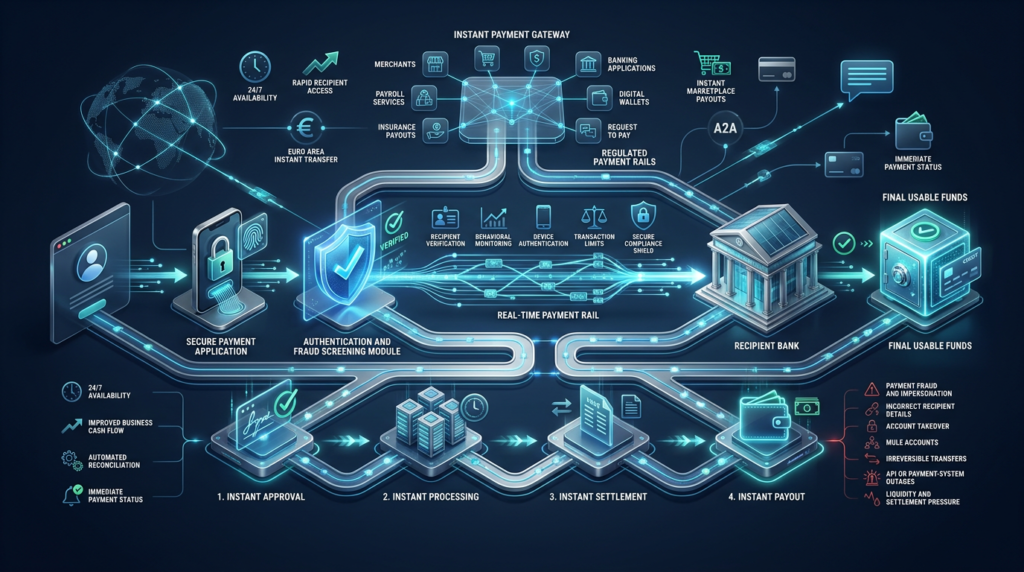
Real-time payments are account-to-account transfers in which the payment message is processed and final funds become available to the recipient within seconds, usually 24/7. The speed depends on the payment rail, participating institutions, fraud controls, and settlement design; an instant authorization or notification alone does not make a payment truly real time.
The terms real-time payments, instant payments, fast payments, and faster payments are often used for similar services.
However, businesses should not judge a payment product only by the word “instant.”
A transaction can receive an instant approval while the merchant waits one or more days for settlement. A payout interface can submit an instruction immediately while the recipient’s bank delays access to the funds. A gateway can process a message quickly without controlling the underlying banking rail.
The most important question is therefore:
When does the recipient receive final, usable funds?What Are Real-Time Payments?
Real-time payments are electronic transfers that deliver final funds to the recipient in real time or near real time and operate as close to 24 hours a day, seven days a week as possible.
The Committee on Payments and Market Infrastructures defines a fast payment by two main outcomes:
- The payment message is transmitted immediately.
- The recipient receives unconditional and irrevocable access to the money almost immediately.
An immediate notification does not qualify when the recipient must wait before using the funds. Likewise, fast card authorization does not necessarily mean that the merchant has received final settlement.
Real-Time Payment Meaning in Simple Terms
A traditional bank transfer may wait for:
- a processing window;
- the next clearing batch;
- the next business day;
- interbank settlement;
- a weekend or holiday to end.
A real-time transfer processes the instruction individually and makes the funds available within seconds.
For example:
- A customer sends money from a banking application.
- The bank authenticates the customer.
- Fraud and compliance checks run.
- The payment system routes the instruction.
- The recipient’s bank accepts the transfer.
- The recipient receives usable funds.
- Both parties receive confirmation.
This process can operate during evenings, weekends, and public holidays when all participating systems support continuous service.
How Real-Time Payments Work
A real-time transaction usually involves several technical and financial layers.
1. Payment initiation
The payer starts the transfer through:
- online banking;
- a mobile banking application;
- a digital wallet;
- a merchant checkout;
- accounting software;
- a payment API;
- a Request to Pay message.
The instruction identifies the amount, payer, recipient, destination account, and payment reference.
2. Authentication
The payer confirms the transaction through an approved method.
Authentication may use:
- a password or PIN;
- device approval;
- one-time code;
- biometric verification;
- hardware security key;
- risk-based authentication.
3. Pre-validation
The service may check the recipient’s name, account identifier, bank participation, transaction limit, and message format before sending the money.
Payment pre-validation reduces incorrect account details, fraud, rejected transfers, and compliance problems before funds move.
4. Fraud and compliance screening
The payer’s provider evaluates:
- unusual transaction behavior;
- account history;
- device information;
- recipient risk;
- sanctions requirements;
- money-laundering indicators;
- transaction velocity.
These checks must complete quickly enough to preserve the real-time customer experience.
5. Clearing
The payment system exchanges the instruction and determines the financial obligations between participating providers.
Unlike traditional batch clearing, a real-time system normally processes each payment continuously.
6. Settlement
Settlement transfers the financial obligation between the payer’s and recipient’s payment service providers.
Some systems settle each transaction immediately.
Other systems provide final funds to the recipient first and settle the positions between providers later. The second model requires credit, liquidity, collateral, limits, or loss-sharing controls because the recipient may already have the money before inter-provider settlement is complete.
7. Recipient credit
The recipient’s provider credits the account and makes the funds available.
8. Confirmation
The payer and recipient receive the final transaction status.
A confirmation should distinguish between:
- submitted;
- accepted;
- rejected;
- pending;
- completed;
- returned.
Real-Time Payment Flow
Payer
  ↓
Bank, wallet, or payment application
  ↓
Authentication and fraud screening
  ↓
Real-time payment rail
  ↓
Clearing and settlement
  ↓
Recipient’s provider
  ↓
Final funds available to recipient
The complete flow must be evaluated.
A fast application cannot compensate for a slow banking rail, delayed recipient credit, or batch-based payout process.
Instant Payments vs Faster Payments
The terms vary between countries and payment systems.
| Term | Typical meaning |
|---|---|
| Real-time payments | Final recipient funds become available within seconds |
| Instant payments | Common European and industry term for real-time transfers |
| Fast payments | Institutional term for near-immediate, continuously available transfers |
| Faster payments | May describe a specific national system or any transfer faster than traditional processing |
| Same-day payments | Completed during the same day but not necessarily within seconds |
| Expedited transfer | Prioritized transfer that may still depend on business hours |
| Instant approval | Immediate acceptance decision, not necessarily movement of funds |
A service that completes in several hours may be faster than a traditional transfer but does not necessarily meet the institutional definition of a fast payment.
Instant Payment Processing
Instant payment processing means that a payment instruction is validated, routed, and responded to immediately.
The processing layer may include:
- customer authentication;
- account validation;
- fraud scoring;
- transaction-limit checks;
- payment-message creation;
- routing;
- status reporting.
Instant processing is important, but it is only one part of the transaction.
A transaction can be processed instantly while settlement or recipient availability remains delayed.
For that reason, businesses should measure at least four separate times:
| Measurement | What it shows |
|---|---|
| Authorization time | How quickly the transaction is approved |
| Processing time | How quickly the instruction is validated and routed |
| Recipient availability time | When the recipient can use the funds |
| Settlement time | When obligations between providers are settled |
What Is an Instant Payment Gateway?
An instant payment gateway is a customer-facing technical service that receives a payment request and connects a merchant or platform with payment processors, banks, wallets, or real-time payment rails.
A gateway may provide:
- checkout interfaces;
- payment APIs;
- customer authentication;
- payment routing;
- transaction status;
- fraud screening;
- refunds;
- reconciliation data;
- merchant reporting.
The gateway does not automatically determine the speed of final settlement.
The underlying payment method matters.
A gateway may connect to:
- real-time bank transfers;
- cards;
- wallets;
- traditional bank transfers;
- local payment schemes;
- cross-border networks.
Each method can have a different timetable.
Instant Approval Payment Gateway
The phrase instant approval payment gateway usually refers to a gateway that returns an immediate authorization decision.
An approval may mean that:
- the account exists;
- sufficient funds appear available;
- authentication succeeded;
- the issuer accepted the transaction;
- preliminary fraud checks passed.
Approval does not necessarily mean that the merchant has received final money.
Card transactions are the clearest example. A card issuer may authorize a purchase in seconds, but merchant clearing and settlement can occur later.
Businesses should not present instant authorization as instant settlement.
Instant Settlement Payment Gateway
The phrase instant settlement payment gateway should be used only when the complete arrangement delivers funds to the merchant or recipient immediately or near immediately.
A gateway can support instant settlement when it connects to:
- a real-time account-to-account rail;
- an immediately funded wallet;
- a continuously operating settlement system;
- a provider that advances final funds under a defined arrangement.
The business should verify:
- whether funds are final or provisional;
- whether settlement works 24/7;
- whether weekends are included;
- whether every supported bank participates;
- whether transaction limits apply;
- whether cross-border payments remain instant;
- whether withdrawals from the platform are separate.
An “available balance” inside a processor dashboard may not equal money settled into the merchant’s bank account.
Instant Payout Payment Gateway
An instant payout payment gateway sends money from a business to a recipient.
Common payout use cases include:
- marketplace seller payments;
- insurance claims;
- employee expenses;
- gig-worker earnings;
- gaming withdrawals;
- customer refunds;
- loan disbursements;
- emergency assistance.
The payout provider may deliver money to:
- a bank account;
- an eligible payment card;
- a digital wallet;
- a prepaid account.
A payout can appear instant to the sender while the recipient waits because of the destination bank, account type, compliance review, region, currency conversion, or local network availability.
Real-Time Payments vs Payment Gateways
| Feature | Real-time payment system | Payment gateway |
|---|---|---|
| Main role | Moves payment instructions and final value | Connects a business interface to payment providers |
| Typical operator | Central bank, banking network, industry utility, or scheme | Payment company, processor, bank, or fintech |
| Customer interface | May be provided through banks and wallets | Often provides checkout or API integration |
| Controls final speed | Yes, together with participating providers | Only indirectly |
| Settlement role | Defines or supports inter-provider settlement | May route to an external settlement rail |
| Merchant integration | Usually indirect | Usually direct |
| Main risk | Fraud, liquidity, operational and settlement risk | Integration, routing, security and provider risk |
A merchant normally does not connect directly to national payment infrastructure.
A bank, payment provider, processor, or embedded finance platform provides that access.
Real-Time Payments and Open Banking
Open banking can initiate an account-to-account payment, but the receiving speed depends on the underlying payment rail.
Open banking provides customer consent, bank authentication, and payment-initiation connectivity. The real-time rail provides clearing, settlement, and rapid recipient availability.
A payment can therefore use open banking without being instant.
Conversely, a customer can send an instant bank transfer directly through a banking application without using a third-party open banking provider.
Real-Time Payments and Embedded Finance
Embedded finance can place instant payouts inside marketplaces, payroll tools, insurance platforms, and mobility applications.
For example, a marketplace may allow a seller to request a payout inside the seller dashboard. The platform submits the instruction through an API, while a bank or payment provider delivers the regulated payment service.
The embedded interface improves convenience, but the supporting infrastructure still determines:
- availability;
- limits;
- fraud controls;
- settlement;
- customer support;
- transaction finality.
Real-Time Payments Visa Services
Searches for real time payments Visa or Visa real time payments normally refer to Visa Direct.
Visa Direct is a commercial money-movement platform that can send funds to eligible cards, accounts, and digital wallets. Visa reports connectivity to more than 18 billion eligible endpoints, more than 150 currencies, and over 90 domestic payment schemes, including more than 20 real-time schemes.
Visa Direct can support:
- person-to-person transfers;
- marketplace payouts;
- insurance disbursements;
- cross-border remittances;
- refunds;
- contractor payments;
- wallet transfers.
Visa Direct is not one universal national real-time payment rail.
The platform connects several card, account, wallet, ACH, RTGS, and real-time networks. Actual availability can depend on the recipient’s institution, account, country, compliance process, currency, and supported endpoint.
Visa Direct vs Domestic Real-Time Payment Systems
| Criterion | Visa Direct | Domestic real-time payment system |
|---|---|---|
| Main model | Commercial global money-movement platform | National or regional account-to-account infrastructure |
| Destinations | Eligible cards, accounts, and wallets | Usually participating bank or payment accounts |
| Geographic scope | Domestic and cross-border | Primarily domestic or regional |
| Currency conversion | Can be part of cross-border service | Often single-currency |
| Settlement model | Depends on destination and connected network | Defined by the domestic system |
| Final availability | Depends on receiving institution and other factors | Usually governed by system rules |
| Typical users | Banks, fintechs, platforms, businesses and governments | Banks, payment institutions, consumers and businesses |
Visa Direct may use or connect with a domestic real-time rail, but the two services should not be treated as identical.
SEPA Instant Payments
SEPA Instant Credit Transfer, commonly called SEPA Instant, supports euro credit transfers in which the recipient normally receives the funds within ten seconds.
The service operates 24 hours a day, every day of the year. The European Payments Council launched the SCT Inst scheme in November 2017.
The EU Instant Payments Regulation expanded access by requiring covered payment service providers that offer ordinary euro credit transfers to provide corresponding instant-transfer services.
For euro-area providers, the main deadlines included:
- receiving instant transfers by January 9, 2025;
- charges no higher than comparable ordinary transfers by January 9, 2025;
- sending instant transfers by October 9, 2025;
- Verification of Payee by October 9, 2025.
Implementation for non-euro-area states and certain payment and electronic-money institutions follows later deadlines through 2027 and 2028.
Verification of Payee
Verification of Payee compares the recipient name entered by the payer with the name associated with the destination account.
The result may indicate:
- match;
- close match;
- no match;
- unavailable or other result.
The check occurs before the transfer is submitted.
The EU framework requires covered providers to offer Verification of Payee for standard and instant euro credit transfers without charging the payer for the check.
Verification of Payee can reduce:
- typing errors;
- payments to incorrect accounts;
- invoice-redirection fraud;
- impersonation scams.
It does not prove that the recipient is honest or that the underlying purchase is legitimate.
Request to Pay
Request to Pay is a messaging service that allows a person or business to send a payment request to a payer.
A request can include:
- amount;
- recipient;
- invoice reference;
- due date;
- payment reason;
- expiry time.
The payer reviews the request and chooses whether to approve or reject it.
Request to Pay is not itself the payment.
Money moves only after the payer authorizes the related transfer.
DuitNow Request to Pay
The keyword DuitNow Request to Pay commonly refers to DuitNow Request, a Malaysian service operated through PayNet-connected banking and e-wallet applications.
A requester can send a payment request using identifiers such as a mobile number, identity number, business registration number, or bank account. The payer reviews and approves the request, after which the recipient receives confirmation and the funds are transferred.
DuitNow Request demonstrates how real-time infrastructure can support an additional messaging layer.
The request creates the payment journey, while the payment rail moves the money after authorization.
Benefits of Real-Time Payments
Immediate recipient access
Recipients can use funds within seconds rather than waiting for the next processing day.
Continuous availability
Transfers can operate during evenings, weekends, and holidays.
Better cash-flow management
Businesses can receive customer funds, supplier payments, refunds, and financing more quickly.
Faster payouts
Marketplaces, employers, insurers, lenders, and governments can distribute funds at the time they are needed.
Improved reconciliation
Structured payment messages and immediate status information can help match payments with invoices or customer records.
Reduced uncertainty
Both sides receive a rapid success or rejection result.
New digital services
Real-time rails can support:
- Request to Pay;
- QR payments;
- mobile aliases;
- automated invoice payment;
- embedded payouts;
- open banking payments.
Main Real-Time Payment Risks
Authorized push payment fraud
A criminal manipulates the payer into approving a transfer.
Examples include:
- fake invoices;
- impersonated bank staff;
- investment scams;
- romance scams;
- account takeover;
- business email compromise.
The bank may process the instruction correctly even though the payer was deceived.
Irrevocability
Final transfers may be difficult to reverse.
Payment finality benefits recipients and merchants, but it reduces the time available to stop fraudulent transactions.
Faster fraud execution
Criminals can move stolen funds through several accounts before the victim recognizes the fraud.
Account takeover
An attacker who controls the payer’s account or device can send money immediately.
Operational outages
A failure at a bank, payment rail, API, identity provider, or fraud system can interrupt service.
Liquidity risk
Participating institutions need sufficient funds, collateral, or credit arrangements to support continuous settlement.
Incorrect recipient details
A typing error can send final funds to the wrong account.
Mule accounts
Fraudsters use intermediary accounts to receive and rapidly forward stolen money.
Cross-border complexity
Currency conversion, different operating rules, sanctions screening, data requirements, and inconsistent technical standards can slow or reject an international transfer.
A 2026 CPMI report identified inconsistent adoption of ISO 20022, different scheme rules, limited multicurrency support, regulatory differences, and unclear governance as major barriers to interlinking real-time systems across borders.
Why Instant Payments Need Pre-Transaction Controls
Traditional payment systems sometimes provide enough delay for a bank or customer to notice and stop a suspicious transaction.
A real-time system removes much of that period.
Risk controls should therefore operate before the final payment is released.
Useful controls include:
- recipient-name verification;
- account validation;
- device intelligence;
- behavioral analysis;
- transaction limits;
- cooling-off periods for new recipients;
- scam warnings;
- confirmation screens;
- sanctions screening;
- mule-account detection;
- unusual-payment alerts.
The strongest control is not always a longer delay.
A better design validates the recipient, context, device, customer behavior, and payment purpose before sending the money.
Instant Payments and Refunds
A refund is not necessarily an automatic reversal of the original transaction.
Possible recovery methods include:
- recipient-authorized return;
- bank recall request;
- fraud investigation;
- scheme return process;
- legal recovery;
- merchant-issued refund.
The success of recovery depends on:
- whether the funds remain in the recipient account;
- system rules;
- fraud evidence;
- local law;
- recipient cooperation;
- provider response time.
Businesses should clearly explain the difference between:
- cancelling a pending payment;
- reversing a card authorization;
- recalling a bank transfer;
- issuing a new refund payment.
Real-Time Payments vs Card Payments
| Feature | Real-time account payment | Card payment |
|---|---|---|
| Funding source | Bank or payment account | Debit or credit card account |
| Approval speed | Usually seconds | Usually seconds |
| Recipient funds | Often available within seconds | Merchant settlement often occurs later |
| Intermediaries | Banks and real-time rail | Issuer, card network, acquirer and processor |
| Chargebacks | Usually limited or different | Established card dispute model |
| Credit option | Normally no | Available through credit cards |
| Finality | Often rapid and difficult to reverse | Authorization may later be disputed or reversed |
| Operating hours | Typically 24/7 | Authorization generally 24/7 |
| Main fraud concern | Manipulated or compromised push transfer | Stolen credentials and unauthorized transactions |
The fastest method is not automatically the safest or most suitable method.
Cards may be stronger for purchases requiring mature dispute protection. Real-time transfers may be better for immediate account-to-account settlement and payouts.
How Businesses Should Evaluate an Instant Payment Gateway
1. Define the actual speed requirement
Determine whether the business needs:
- instant approval;
- instant customer confirmation;
- instant recipient availability;
- instant merchant settlement;
- instant withdrawal;
- instant cross-border payout.
These requirements are different.
2. Identify the underlying rails
Ask which systems move the money.
The provider may use:
- domestic real-time payments;
- cards;
- wallets;
- ordinary bank transfers;
- internal ledger transfers;
- cross-border correspondent banking.
3. Check recipient coverage
Verify:
- supported banks;
- supported account types;
- countries;
- currencies;
- cards;
- wallets;
- operating hours.
4. Confirm the meaning of “instant”
Request a written definition.
Determine whether the term measures:
- API response;
- payment submission;
- authorization;
- recipient credit;
- merchant balance;
- bank settlement.
5. Review transaction finality
Ask when the funds become unconditional and whether the provider can reverse or freeze them.
6. Examine fraud controls
The system should support:
- payee verification;
- transaction monitoring;
- velocity limits;
- account validation;
- sanctions controls;
- configurable thresholds;
- fraud-case management.
7. Understand reconciliation
The provider should return unique references, timestamps, final status, fees, and settlement information.
8. Test failure scenarios
Test:
- bank unavailable;
- recipient account closed;
- duplicate request;
- timeout;
- uncertain status;
- incorrect recipient;
- rejected transaction;
- delayed recipient credit.
9. Review refund and recovery procedures
The business should know who initiates a recall and how quickly fraud cases are handled.
10. Compare complete costs
Costs may include:
- transaction fees;
- gateway fees;
- monthly minimums;
- cross-border charges;
- currency conversion;
- fraud tools;
- failed-payment charges;
- payout fees;
- reconciliation services.
Practical Note: The best default is a provider that defines “instant” as final recipient availability, identifies the exact underlying rail, supports payee validation, returns a definitive transaction status, and documents what happens during timeouts, fraud cases, and provider outages.
Common Real-Time Payment Mistakes
Treating approval as settlement
An approved payment may still require clearing and settlement.
Looking only at the customer interface
A fast checkout does not prove that the recipient receives final funds instantly.
Ignoring recipient-bank coverage
The payer’s provider may support real-time transfers while the recipient’s institution does not.
Assuming every cross-border payment is instant
International transfers may require currency conversion, sanctions controls, additional providers, and different national systems.
Failing to validate the recipient
Speed increases the cost of sending money to an incorrect or fraudulent account.
Using “instant payout” for an internal balance
Money displayed in a platform wallet may still require a separate withdrawal to a bank.
Designing fraud controls after launch
Real-time fraud must usually be detected before the payment becomes final.
Assuming every payment can be reversed
Final account-to-account payments may not provide card-style chargebacks.
Frequently Asked Questions
What are real-time payments?
Real-time payments are electronic transfers that process the payment message and make final funds available to the recipient within seconds, usually through a service operating continuously.
Are real-time payments the same as instant payments?
The terms usually describe the same general concept. The EU commonly uses “instant payments,” while institutions may use “fast payments” or “real-time payments.”
How fast is a real-time payment?
The exact target depends on the system. SEPA Instant normally makes euro funds available within ten seconds, while other systems may use different limits.
Do real-time payments work 24/7?
Most true real-time systems are designed for continuous operation, including nights, weekends, and holidays. Individual providers may still schedule maintenance or apply restrictions.
What is instant payment processing?
Instant payment processing is the immediate validation and routing of a payment instruction. It does not automatically prove that interbank settlement or recipient access is also immediate.
What is an instant payment gateway?
An instant payment gateway is an interface or API that connects a merchant or platform with payment providers and payment rails. Final speed depends on the method and infrastructure used behind the gateway.
Is instant approval the same as instant settlement?
No. Instant approval confirms that a transaction was accepted. Instant settlement means that the financial obligation has been completed under the applicable settlement arrangement.
What is an instant payout?
An instant payout sends funds from a business or platform to a recipient within seconds or minutes through an eligible account, card, or wallet.
Does Visa offer real-time payments?
Visa Direct supports fast money movement to eligible cards, accounts, and wallets and connects with multiple domestic real-time schemes. Actual fund availability depends on the receiving institution, account, region, and other factors.
What are SEPA instant payments?
SEPA instant payments are euro credit transfers made through the SCT Inst scheme. Funds are normally available to the recipient within ten seconds, 24 hours a day.
What is Request to Pay?
Request to Pay is a message asking a payer to approve a payment. The request does not move money until the payer authorizes the related transfer.
Can a real-time payment be reversed?
A completed payment may be difficult to reverse. Recovery can depend on scheme rules, recipient cooperation, fraud procedures, provider action, and local law.
Are real-time payments safe?
Real-time systems can use authentication, payee validation, fraud monitoring, and transaction controls. The speed and finality of the transfer can still increase losses from scams, account takeover, and incorrect recipient details.
Are instant payments better than cards?
Instant payments can provide faster account-to-account fund availability. Cards may provide credit and more established chargeback protections. The better option depends on the transaction and required consumer protection.
Final Thoughts
Real-time payments change more than transaction speed.
A complete real-time service combines:
- continuous availability;
- authentication;
- payment-message processing;
- fraud controls;
- clearing;
- settlement;
- final recipient access;
- immediate status information.
The visible payment button is only the first layer.
A provider may market instant approval, instant processing, instant payout, and instant settlement as though each phrase means the same thing. They do not.
The most reliable evaluation rule is:
Measure the payment from customer authorization
to final recipient access—not only the gateway response.
Real-time infrastructure can improve cash flow, payouts, reconciliation, customer experience, and financial access.
The same infrastructure reduces the time available to identify errors and fraud.
Strong real-time payment systems therefore combine speed with recipient verification, pre-validation, transaction monitoring, clear finality rules, operational resilience, and defined recovery procedures.
Speed is the visible feature.
Finality and risk control determine whether the payment service is dependable.