
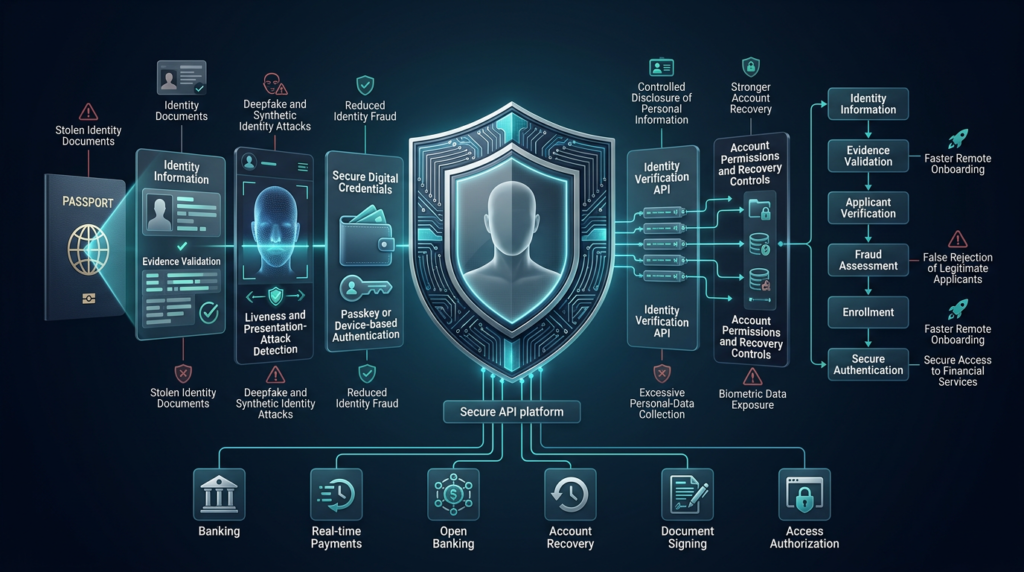
Digital identity is a set of electronically stored attributes, credentials, and authenticators that represents a person, organization, or device in a digital system. A reliable identity process establishes that the claimed identity exists, verifies that the applicant is connected to it, and later authenticates the enrolled user when access or a transaction is requested.
A digital identity may be used to:
- open a financial account;
- access government or business services;
- approve payments;
- sign documents;
- recover an online account;
- verify age or eligibility;
- connect financial applications;
- authorize access to sensitive information.
A username alone is not a complete identity.
A strong system combines verified information, credentials, authentication methods, security controls, privacy protections, and account-recovery procedures.
What Is Digital Identity?
Digital identity is an electronic representation of an individual or entity within a defined system.
The representation may contain:
- legal name;
- date of birth;
- address;
- government identifier;
- email address;
- telephone number;
- account identifier;
- verified credentials;
- device information;
- biometric reference;
- authentication history;
- permissions and entitlements.
The exact information depends on the purpose of the service.
A government identity program may require evidence of legal identity. A bank may need information required for account opening and regulatory checks. A retail application may only need an email address and proof that the user controls it.
The World Bank defines a digital ID system as one that uses digital technology throughout the identity lifecycle, including data capture, validation, storage, credential management, verification, and authentication.
Digital Identity Meaning in Simple Terms
A digital identity answers two related questions:
Who is this person within the system?and:
How can the system recognize the same person later?During registration, the service may inspect identity evidence and connect it to the applicant.
After registration, the user may prove control of the enrolled account through:
- a password;
- a passkey;
- a security key;
- a mobile device;
- an authentication application;
- a biometric unlock;
- another approved authenticator.
The information used to establish the identity does not have to be presented during every login.
A person may use a passport during initial enrollment but later authenticate with a passkey bound to the verified account.
What Makes Up a Digital Identity?
A complete identity normally contains several layers.
Identity attributes
Attributes describe the person or entity.
Examples include:
- name;
- date of birth;
- residential address;
- nationality;
- business role;
- account ownership;
- professional qualification.
Identity evidence
Identity evidence supports the claimed attributes.
Possible evidence includes:
- passport;
- national identity card;
- driving licence;
- residence permit;
- digital government credential;
- trusted database record;
- verified bank-account information.
NIST recognizes that evidence can be physical or digital. The evidence must be evaluated according to its strength, issuing source, security features, validity, and relevance to the required assurance level.
Digital credentials
A credential is something issued or bound to an identity after enrollment.
Examples include:
- digital certificate;
- mobile identity credential;
- verified account;
- identity wallet credential;
- employee credential;
- digitally signed assertion.
Authenticators
An authenticator is used to demonstrate control of the enrolled account.
Examples include:
- password;
- one-time code;
- passkey;
- hardware security key;
- authentication application;
- cryptographic mobile credential.
Activity and trust records
A service may also maintain:
- enrollment history;
- successful and failed logins;
- connected devices;
- account-recovery events;
- consent records;
- risk signals;
- verification results.
These records can help detect fraud, but collecting too much information creates additional privacy and security exposure.
Digital Identity Is Not the Same as an Online Profile
An online profile can contain information a user entered without independent verification.
A social-media account, forum username, or shopping profile may represent the same person consistently while providing little assurance about the person’s legal identity.
| Concept | What it represents | Typical assurance |
|---|---|---|
| Online profile | User-created information and activity | Low or unknown |
| Account | Relationship between a user and a service | Depends on enrollment |
| Credential | Evidence or assertion connected to an identity | Varies by issuer |
| Digital identity | Attributes, credentials, authenticators, and records within an identity system | Depends on proofing and controls |
| Legal identity | Identity recognized under applicable law | Requires authoritative evidence |
A service should request stronger evidence only when the transaction risk justifies it.
A newsletter subscription does not normally require the same assurance as opening a bank account or recovering access to a high-value financial account.
Identification vs Verification vs Authentication
These terms are related but not interchangeable.
| Process | Main question | Example |
|---|---|---|
| Identification | Who is the person claiming to be? | The applicant provides a name and date of birth |
| Resolution | Does the information identify one real person in the relevant population? | Records are assembled around the claimed identity |
| Validation | Is the evidence authentic, accurate, and valid? | A passport is checked against trusted information |
| Verification | Is the applicant the person connected to the evidence? | A live face is compared with the document portrait |
| Authentication | Is the current user the previously enrolled account holder? | The user signs in with a passkey |
| Authorization | What is the authenticated user allowed to do? | The user can view an account but cannot approve a large payment |
NIST structures identity proofing around resolution, validation, and verification. Successful proofing can then lead to enrollment and the binding of authenticators to the subscriber account.
Verification usually occurs during enrollment or a high-risk recovery event.
Authentication can occur every time the user logs in, grants consent, or approves an important transaction.
How Digital Identity Verification Works
A typical online process contains the following stages.
Step 1: Information collection
The applicant provides the minimum information needed for the service.
The requested data may include:
- name;
- date of birth;
- address;
- identity-document details;
- telephone number;
- email address.
The provider should explain why the information is required and how long it will be retained.
Step 2: Identity resolution
The service determines whether the submitted attributes describe a real and sufficiently distinct identity.
The system may compare the information with:
- issuing-authority records;
- credit-header data;
- telephone or address records;
- trusted government databases;
- other authoritative or credible sources.
Resolution does not prove that the applicant owns the identity.
It establishes that the claimed identity can be meaningfully distinguished within the relevant population.
Step 3: Evidence validation
The provider evaluates whether the evidence is genuine and valid.
A document check may examine:
- expiration date;
- document number;
- security features;
- machine-readable zone;
- barcode or chip data;
- signs of alteration;
- information consistency;
- issuing-authority confirmation.
Step 4: Applicant verification
The service connects the applicant to the evidence.
Methods may include:
- facial comparison;
- possession of a digital credential;
- confirmation code sent to a validated address;
- attended video session;
- in-person inspection;
- cryptographic proof from an identity wallet.
Step 5: Fraud and risk assessment
The provider may assess:
- device integrity;
- network information;
- automated bot activity;
- duplicate enrollment;
- forged media;
- suspicious document patterns;
- repeated failed attempts;
- links to previously detected fraud.
NIST Revision 4 expanded identity-proofing requirements for injection attacks, forged media, and other fraud threats that have become more important with synthetic images and deepfakes.
Step 6: Enrollment
After successful proofing, the provider creates or updates the subscriber account.
One or more authenticators are bound to the identity so the same person can authenticate later.
Step 7: Notification and recovery setup
The provider may notify the applicant through a validated address and establish recovery methods.
Notification can alert a victim when someone has attempted to create an account using stolen identity information.
Types of Identity Verification
Document-based verification
The applicant photographs or scans an identity document.
The service examines the document and extracts relevant information.
This method is common but depends on:
- image quality;
- document coverage;
- access to trusted validation sources;
- ability to detect alterations;
- ability to connect the document to the applicant.
Database verification
Submitted attributes are compared with authoritative or credible records.
Database agreement can strengthen validation, but matching personal information alone may not prove that the applicant is the owner.
Stolen names, dates of birth, addresses, and identifiers may be known to criminals.
Biometric verification
A biometric sample is compared with a trusted reference.
Common modalities include:
- face;
- fingerprint;
- iris;
- voice.
Biometric comparison can connect the applicant to an identity document or enrolled account, but biometric data should not be treated as secret. A face is visible, a voice can be recorded, and biometric characteristics cannot be changed as easily as a password.
Attended verification
A trained agent reviews the applicant and evidence in person or through a secure video session.
Attended verification can help resolve unusual cases, but quality depends on agent training, procedures, evidence, and the security of the communication channel.
Digital credential verification
The applicant presents a digitally signed credential issued by a trusted organization.
The receiving service validates:
- issuer;
- digital signature;
- credential status;
- requested attributes;
- proof of control.
This model can reduce repeated document collection when the trust framework and interoperability standards are reliable.
What Is an Online Identity Verification Service?
An online identity verification service helps another business establish that an applicant is connected to a claimed identity.
The service may provide:
- document capture;
- document validation;
- facial comparison;
- liveness or presentation-attack detection;
- database checks;
- device intelligence;
- fraud scoring;
- manual review;
- verification results;
- audit records.
An identity verification service does not necessarily make the final business decision.
The customer-facing company may combine the provider’s result with:
- transaction risk;
- account type;
- geographic rules;
- internal fraud data;
- regulatory requirements;
- manual review.
A “verified” response should always be interpreted according to the checks performed and the assurance level achieved.
Identity Verification Online: Automated vs Attended
| Method | Main advantage | Main limitation |
|---|---|---|
| Remote unattended | Fast and scalable | More exposed to automation and presentation attacks |
| Remote attended | Agent can question and inspect the applicant | Higher cost and scheduling friction |
| On-site unattended | Uses controlled equipment | Requires physical access to a kiosk or location |
| On-site attended | Stronger human and environmental control | Least convenient and most expensive |
NIST recognizes all four models and recommends providing multiple pathways when possible so people with different documents, devices, capabilities, and circumstances can complete the process.
A stronger service is not always the one that forces every applicant into the same automated journey.
A reliable system also needs exception handling for:
- damaged documents;
- recent name changes;
- limited device access;
- accessibility needs;
- poor connectivity;
- applicants without standard evidence.
What Is Biometric Verification?
Biometric verification compares a biological or behavioral characteristic with a previously trusted reference.
In remote facial verification, the system may:
- extract the portrait from an identity document;
- capture a live image or video;
- assess whether a real person is present;
- compare the facial characteristics;
- calculate a match result;
- combine the result with other fraud signals.
The match score is not absolute proof.
The result depends on:
- camera quality;
- lighting;
- pose;
- image resolution;
- algorithm;
- threshold;
- demographic performance;
- presentation-attack controls.
Liveness Detection and Presentation-Attack Detection
Presentation-attack detection attempts to distinguish a live applicant from an imitation.
Possible attacks include:
- printed photograph;
- photograph displayed on another screen;
- replayed video;
- mask;
- face morph;
- injected camera stream;
- synthetic or deepfake video.
NIST SP 800-63A-4 requires remote biometric collection under its federal framework to use presentation-attack detection with an impostor attack presentation accept rate below 0.07. NIST also requires relevant testing to follow recognized biometric testing standards. This threshold is a technical requirement within the NIST framework, not a universal guarantee that every attack will be detected.
A service should not rely on a simple instruction such as asking the applicant to blink.
Modern attacks may reproduce basic movements convincingly.
Biometric Accuracy and False Results
Biometric systems can produce two important errors.
False acceptance
The system incorrectly accepts an impostor.
A low false-acceptance rate is important when unauthorized access could produce substantial harm.
False rejection
The system rejects the legitimate applicant.
False rejection can prevent customers from:
- opening accounts;
- accessing funds;
- receiving services;
- recovering compromised accounts.
NIST testing has found that face-recognition performance can vary across algorithms and demographic groups. Image quality also has a strong effect on false-negative outcomes.
A responsible system needs a human review or alternative verification route rather than treating every automated rejection as proof of fraud.
Digital Identity Platform
A digital identity platform coordinates identity information, verification, credentials, authenticators, permissions, and trust relationships.
A platform may include:
- enrollment interface;
- identity-proofing engine;
- credential service;
- authentication service;
- consent management;
- identity wallet;
- account recovery;
- fraud monitoring;
- audit logs;
- federation services;
- administrative controls.
The platform may be operated by:
- government authority;
- bank;
- technology provider;
- industry consortium;
- employer;
- specialized identity company.
A digital identity platform should not become an unrestricted central collection point for every available personal attribute.
The design should limit collection and disclosure to what each transaction requires.
Digital Identity System
A digital identity system is the wider combination of technology, people, rules, institutions, credentials, and processes used throughout the identity lifecycle.
The lifecycle may cover:
- registration;
- proofing;
- enrollment;
- credential issuance;
- authentication;
- attribute updates;
- account recovery;
- suspension;
- revocation;
- closure.
The distinction is useful:
Digital identity platform = technical and operational product
Digital identity system = platform plus governance, participants, rules, and lifecycle
A technically strong platform can still produce poor outcomes when governance, accountability, privacy, or recovery procedures are weak.
Digital Identity Solution
The term digital identity solution can describe one product or an integrated set of products.
Possible solutions include:
- document-verification software;
- biometric comparison;
- passkey authentication;
- reusable digital credentials;
- identity wallets;
- customer identity and access management;
- fraud-detection services;
- federation infrastructure.
Businesses should define the problem before choosing technology.
A company attempting to reduce account takeover needs a different solution from a company that must establish legal identity during account opening.
What Is an Identity Verification API?
An identity verification API allows a business application to submit verification requests and receive structured results from an identity provider.
A typical API workflow may:
- create a verification session;
- generate a secure customer link;
- receive document images;
- request biometric capture;
- run validation and fraud checks;
- return a status;
- provide reason codes;
- send a completion notification;
- store an audit reference.
Possible results include:
- verified;
- rejected;
- additional information required;
- manual review;
- expired;
- cancelled.
The API should return more than a single confidence score.
The business needs enough information to understand:
- which checks were completed;
- which evidence was used;
- why the process failed;
- whether retry is appropriate;
- whether manual review is needed.
Identity Verification API Security
An API integration should protect:
- session creation;
- customer links;
- uploaded evidence;
- biometric information;
- webhook messages;
- verification decisions;
- administrative access.
Important controls include:
- authenticated encrypted channels;
- short-lived session tokens;
- signed webhook messages;
- access restrictions;
- replay protection;
- audit logs;
- retention controls;
- vendor-risk assessment.
NIST requires protected channels, encryption of collected personal information, automated attack protection, and assessment of third-party supply-chain risk within covered identity-proofing systems.
Digital Identity Assurance Levels
Identity assurance describes confidence that the digital identity belongs to the person using it.
NIST uses separate assurance concepts for:
- identity proofing;
- authentication;
- federation.
The appropriate level depends on potential harm.
A low-risk discussion forum may accept a pseudonymous account. A financial service allowing access to funds needs stronger proofing and authentication. A high-impact government or regulated transaction may require stronger evidence, controls, and recovery procedures.
Higher assurance generally increases:
- security;
- evidence requirements;
- operational cost;
- user effort;
- risk of excluding applicants who lack standard documents or devices.
The correct objective is not maximum verification for every user.
The correct objective is sufficient assurance for the risk of the transaction.
Digital Identity and eKYC
Digital identity is the wider concept.
Electronic Know Your Customer, or eKYC, is a regulated onboarding process used by banks and other covered businesses to identify customers, assess risk, and complete required compliance checks electronically.
A digital identity solution can provide evidence and verification tools used inside eKYC.
However, identity verification alone does not complete:
- sanctions screening;
- politically exposed person checks;
- customer risk assessment;
- beneficial-owner verification;
- ongoing monitoring;
- regulatory recordkeeping.
These requirements belong in the separate eKYC article and should not be merged into the present page.
Digital Identity in Financial Services
Financial institutions use identity processes for:
- account opening;
- payment authentication;
- fraud prevention;
- account recovery;
- loan applications;
- regulatory onboarding;
- customer consent;
- high-risk transaction review.
The required controls may change during the account lifecycle.
A low-risk login may use a passkey. A password reset from a new device may trigger stronger authentication. A request to change the registered phone number or withdraw a large amount may require additional verification.
Digital Identity and Real-Time Payments
Digital identity verification can reduce friction in real-time payments by confirming the payer, protecting account recovery, and supporting risk-based transaction checks.
Real-time payment systems leave little time to stop a fraudulent transfer after authorization. Identity, device, behavioral, and recipient controls therefore need to operate before funds become final.
The identity system does not determine payment settlement speed, but it can reduce the probability that a criminal controls the account or impersonates the customer.
Digital Identity and Open Banking
Open banking providers use digital identity and authentication controls to confirm who is granting consent before account data or payment initiation is authorized.
The identity process can involve:
- customer authentication by the bank;
- identification of the third-party provider;
- consent records;
- authorization scopes;
- expiry and revocation;
- fraud monitoring.
Open banking does not require the third party to collect a new passport each time the customer connects an account. The bank can authenticate its existing customer and provide a controlled authorization result.
Benefits of Digital Identity
Faster onboarding
Automated evidence capture and validation can reduce manual processing.
Remote access
Customers can access services without visiting a physical branch or office.
Reusable credentials
Trusted credentials may reduce repeated document uploads.
Stronger fraud controls
Identity proofing can detect altered documents, duplicated identities, bots, and impersonation attempts.
Better customer control
Consent and attribute-based systems can allow users to disclose only the information needed.
For example, a service may need confirmation that a customer is over a specified age rather than the complete date of birth.
More consistent records
Structured identity information can reduce transcription errors and inconsistent manual records.
Interoperability
Federation and digital credentials can allow multiple services to rely on a trusted identity provider under an agreed framework.
Main Digital Identity Risks
Personal data exposure
Identity systems may store documents, addresses, biometrics, identifiers, and account history.
A breach can expose information that cannot be easily replaced.
Identity theft
Criminals can use stolen evidence to create accounts or take over existing identities.
Synthetic identity fraud
A synthetic identity combines real and invented attributes to create a new identity record.
Deepfake and injection attacks
Attackers may inject altered images, synthetic video, or manipulated document feeds directly into the verification process.
Biometric permanence
A compromised password can be replaced.
A person cannot easily replace a face, fingerprint, or iris.
False rejection
A legitimate applicant may be unable to complete verification because of document quality, disability, appearance changes, device limitations, or algorithmic errors.
Demographic performance differences
A system may perform differently across population groups if algorithms, thresholds, training data, or capture conditions are not adequately evaluated.
Vendor dependency
A service may depend on one provider for documents, biometrics, databases, and account recovery.
An outage or provider failure can block every customer.
Function creep
Information collected for identity proofing may later be used for unrelated analytics, marketing, surveillance, or profiling.
Recovery weakness
A strong login process can be undermined by a weak password-reset or account-recovery journey.
Why Collecting More Identity Data Can Reduce Security
Collecting additional information may appear to increase confidence.
In practice, unnecessary collection creates:
- larger breach impact;
- more access points;
- greater insider risk;
- more complicated retention;
- additional compliance obligations;
- more information available for impersonation.
NIST requires identity-proofing information to be limited to what is necessary for proofing, fraud mitigation, and authorized attribute decisions. NIST also requires explicit notice about collection, storage, retention, deletion, and redress.
The best default is not to create the largest possible identity profile.
The best default is to collect the smallest amount of information that achieves the required assurance.
Practical Note: A strong identity process does not maximize friction or data collection. It combines risk-appropriate evidence, secure authentication, limited data use, effective fraud controls, alternative verification paths, and a recovery process that does not become the weakest point.
How to Evaluate Identity Verification Solutions
1. Define the required assurance
Decide what harm could result from a false acceptance or false rejection.
2. Identify supported evidence
Check which documents, digital credentials, jurisdictions, and languages are supported.
3. Review authoritative validation
Determine whether information is merely extracted from the document or checked with a trusted source.
4. Evaluate biometric controls
Review:
- algorithm testing;
- presentation-attack detection;
- injection-attack controls;
- demographic testing;
- false-acceptance rates;
- false-rejection rates.
5. Examine manual review
Determine when a case is escalated and how reviewers are trained.
6. Check privacy and retention
Confirm:
- which information is stored;
- where it is stored;
- how long it is retained;
- which providers receive it;
- how deletion works.
7. Test accessibility
The service should support applicants with:
- older devices;
- poor connectivity;
- disabilities;
- name changes;
- damaged documents;
- limited technical skills.
8. Review API reliability
Test timeouts, duplicate requests, expired sessions, uncertain results, and webhook failures.
9. Inspect account recovery
Determine how the service handles:
- lost devices;
- changed phone numbers;
- compromised accounts;
- failed biometrics;
- deceased or incapacitated users.
10. Require meaningful reason codes
A rejected applicant should receive a practical explanation and a review path rather than an unexplained failure.
Digital Identity Evaluation Checklist
| Question | Stronger signal | Warning signal |
|---|---|---|
| What is being verified? | Clearly defined identity claim | Vague “verified user” label |
| Which evidence is used? | Documented trusted evidence | Unexplained database score |
| Is evidence validated? | Issuer or authoritative checks | Data extraction only |
| How is the applicant connected? | Multi-signal verification | Personal knowledge questions alone |
| How are presentation attacks handled? | Tested PAD and injection controls | Basic selfie capture only |
| Is biometric performance published? | Measured error and demographic results | “Highly accurate” marketing claim |
| What data is retained? | Limited, documented retention | Indefinite storage |
| Is there an alternative route? | Manual or attended review | Automated rejection is final |
| Can users correct errors? | Accessible redress process | No appeal mechanism |
| How is recovery protected? | Risk-based verified recovery | Email reset overrides all controls |
Common Digital Identity Mistakes
Treating verification as authentication
Proofing the applicant once does not secure future account access.
Treating authentication as authorization
A valid login does not mean the user should be permitted to perform every action.
Relying on document images alone
A realistic image may still be altered, stolen, expired, or unrelated to the applicant.
Treating biometrics as passwords
Biometrics are useful comparison signals but cannot be kept secret in the same way as cryptographic keys.
Collecting every available attribute
Unnecessary data increases risk without always increasing assurance.
Providing no alternative path
A purely automated process can exclude legitimate applicants.
Hiding the verification provider
Customers should understand which organization processes their documents and biometric information.
Ignoring recovery
Attackers commonly target the process used when normal authentication fails.
Using one risk level for every action
Viewing a low-value account and changing its recovery details should not require identical controls.
Frequently Asked Questions
What is digital identity?
Digital identity is an electronic representation of a person, organization, or device within a system. It can include verified attributes, credentials, authenticators, account records, permissions, and trust information.
What is an example of a digital identity?
A verified banking account linked to a customer’s identity information, mobile device, and passkey is one example. A government-issued mobile identity credential is another.
Is digital identity the same as an online account?
No. An online account may be created with unverified information. A digital identity can include evidence, verification results, credentials, authenticators, and assurance records.
What is digital identity verification?
Digital identity verification confirms that the applicant presenting identity information is connected to the claimed identity and supporting evidence.
How does identity verification online work?
The service collects identity information, validates evidence, connects the applicant to that evidence, checks for fraud, and enrolls the verified user into an account.
What is an online identity verification service?
An online identity verification service provides document, database, biometric, fraud, and manual-review tools that businesses use to verify applicants remotely.
What is biometric verification?
Biometric verification compares a characteristic such as a face or fingerprint with a trusted reference to determine whether the applicant is the same person.
Is biometric verification completely accurate?
No. Biometric systems can falsely accept impostors or falsely reject legitimate applicants. Performance depends on the algorithm, capture quality, threshold, attack controls, and population tested.
What is liveness detection?
Liveness detection is part of presentation-attack detection. It attempts to determine whether the captured biometric comes from a live person rather than a photograph, replay, mask, or synthetic source.
What is a digital identity platform?
A digital identity platform provides technical components for enrollment, verification, credentials, authentication, consent, fraud controls, federation, and account recovery.
What is a digital identity system?
A digital identity system includes the platform, institutions, people, rules, governance, credentials, security controls, and complete identity lifecycle.
What is an identity verification API?
An identity verification API connects a business application with a verification provider. The API creates sessions, receives evidence, initiates checks, and returns structured results.
Can digital identity be stolen?
Identity evidence, credentials, accounts, and personal information can be stolen or misused. Strong authentication, limited data collection, encryption, monitoring, and secure recovery reduce the risk.
Is digital identity verification the same as KYC?
No. Identity verification confirms identity-related claims. KYC also includes customer due diligence, risk assessment, sanctions checks, beneficial ownership, recordkeeping, and potentially ongoing monitoring.
Final Thoughts
Digital identity is not one document, biometric scan, username, or database record.
A complete identity framework combines:
- identity attributes;
- trustworthy evidence;
- validation;
- applicant verification;
- enrollment;
- credentials;
- authentication;
- authorization;
- fraud controls;
- recovery;
- privacy and redress.
The strongest identity system does not attempt to prove everything about every user.
It establishes the specific identity claim needed for the transaction at an assurance level appropriate to the potential harm.
Biometric verification can improve remote enrollment, but biometrics require presentation-attack detection, performance testing, alternative verification pathways, and strict data protection.
Identity verification APIs can reduce development time, but an API response is only as meaningful as the evidence, validation sources, algorithms, thresholds, and review process behind it.
The practical decision rule is:
Collect the minimum identity information needed,
verify it to the level required by the risk,
and provide a secure alternative when automation fails.
Convenience determines whether customers complete the process.
Assurance, privacy, recoverability, and accountability determine whether the resulting identity can be trusted.